Should I Be Worried About My Moles?
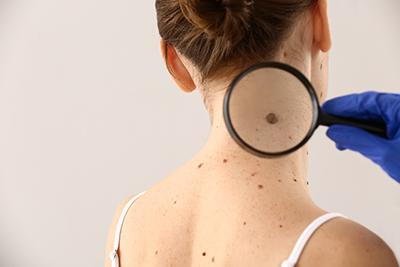
Most moles are normal, but sun exposure, genetics, and other factors can work to turn a normal mole into an abnormal, even cancerous mole. It’s important to know what to look for in abnormal moles. Knowing the signs and symptoms of an abnormal mole can even protect you from skin cancer.
Moles are caused by skin cells known as melanocytes. These melanocytes are responsible for determining skin color. Melanocytes can clump together, causing a mole to form.
So, when should you worry about a mole?
Abnormal Moles Typically Are:
- Large, usually over 6 millimeters in diameter
- Irregularly shaped, usually with ragged borders
- Asymmetrical, usually not uniform in shape
In Addition, You Need to Watch Out for Moles That Are:
- Itching, burning, or painful
- Bleeding or oozing
- Recurring after being previously removed
You should perform a self-check of your moles regularly, looking for any of the signs and symptoms listed above. In fact, pay attention to any mole that has changed in size, color, height, or shape.
You should also visit your dermatologist regularly, especially if you are at a high risk for skin cancer. People who are at a higher risk of skin cancer:
- Burn easily
- Have fair skin, light hair, and light eyes
- Have a family history of skin cancer
When you visit your dermatologist, your doctor may want to biopsy the mole to check for abnormalities. This means taking a sample of tissue or removing the mole entirely. This can be done several ways, including:
Shaving the mole if the mole is small; this option doesn’t require sutures.
Removal of the mole with an instrument, if the mole is large; this option requires a few sutures.
MOHS micrographic surgery, which removes the mole one layer at a time, and the tissue is examined under a microscope.
Remember to protect yourself against skin damage and skin cancer by always wearing a sunscreen of at least SPF 15, or 30 if you are out in the sun for an extended period. Use a higher SPF of 50 and above if you are at high risk for skin cancer.
To learn more about the signs and symptoms of an abnormal mole, and mole removal options, talk with your dermatologist. Call today.
Should I Be Worried About My Moles?
Most moles are normal, but sun exposure, genetics, and other factors can work to turn a normal mole into an abnormal, even cancerous mole. It’s important to know what to look for in abnormal moles. Knowing the signs and symptoms of an abnormal mole can even protect you from skin cancer.
Moles are caused by skin cells known as melanocytes. These melanocytes are responsible for determining skin color. Melanocytes can clump together, causing a mole to form.
So, when should you worry about a mole?
Abnormal Moles Typically Are:
- Large, usually over 6 millimeters in diameter
- Irregularly shaped, usually with ragged borders
- Asymmetrical, usually not uniform in shape
In Addition, You Need to Watch Out for Moles That Are:
- Itching, burning, or painful
- Bleeding or oozing
- Recurring after being previously removed
You should perform a self-check of your moles regularly, looking for any of the signs and symptoms listed above. In fact, pay attention to any mole that has changed in size, color, height, or shape.
You should also visit your dermatologist regularly, especially if you are at a high risk for skin cancer. People who are at a higher risk of skin cancer:
- Burn easily
- Have fair skin, light hair, and light eyes
- Have a family history of skin cancer
When you visit your dermatologist, your doctor may want to biopsy the mole to check for abnormalities. This means taking a sample of tissue or removing the mole entirely. This can be done several ways, including:
Shaving the mole if the mole is small; this option doesn’t require sutures.
Removal of the mole with an instrument, if the mole is large; this option requires a few sutures.
MOHS micrographic surgery, which removes the mole one layer at a time, and the tissue is examined under a microscope.
Remember to protect yourself against skin damage and skin cancer by always wearing a sunscreen of at least SPF 15, or 30 if you are out in the sun for an extended period. Use a higher SPF of 50 and above if you are at high risk for skin cancer.
To learn more about the signs and symptoms of an abnormal mole, and mole removal options, talk with your dermatologist. Call today.

Ormond Beach
400 Lakebridge Plaza Drive
Ormond Beach, FL 32174
Phone: (386) 677-9044
Ormond Beach
1385 West Granada Blvd., Ste 1
Ormond Beach, FL 32174
Phone: (386) 677-9044
Port Orange
1175 Dunlawton Avenue, Unit 102
Port Orange, FL 32127
Phone: (386) 265-1913
New Smyrna Beach
501 South Orange Street
New Smyrna Beach, FL 32168
Phone: (386) 410-5045
Palm Coast
33 & 37 Old Kings Road North
Palm Coast, FL 32137
Phone: (386) 225-4607
Orange City
2515 Junior Street
Orange City, FL 32763
Phone: (386) 218-6806